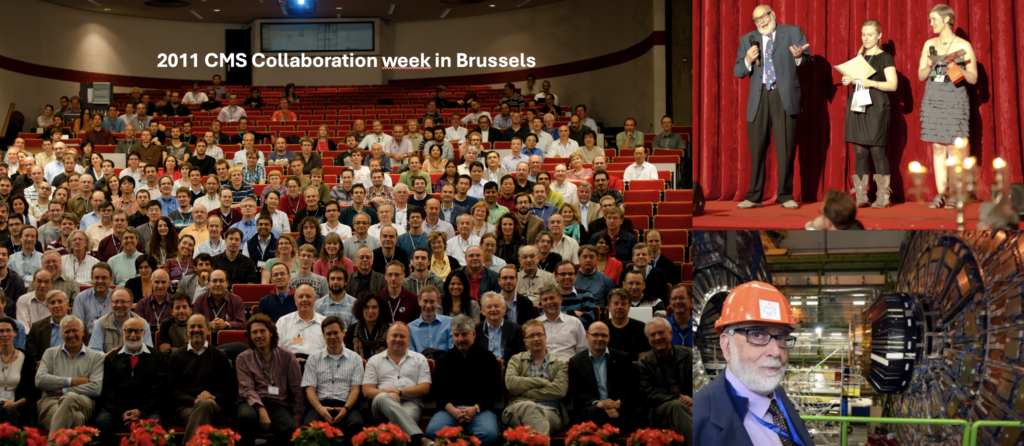
In memory of François Englert
The IIHE community deeply mourns the loss of François Englert, who passed away on 18 June 2026 at the age of 93. He was one of the most remarkable physicists of our time and a key figure in the history of modern particle physics.
Born in 1932 in Brussels, François Englert dedicated his scientific career to understanding the fundamental laws of nature. Together with Robert Brout, he developed in 1964 the mechanism explaining how elementary particles acquire mass through the spontaneous breaking of a gauge symmetry. This theoretical breakthrough, now known as the Brout–Englert–Higgs mechanism, became a cornerstone of the Standard Model of particle physics. Its experimental confirmation, with the discovery of the scalar boson at CERN in 2012 by the ATLAS and CMS collaborations, marked one of the greatest achievements in particle physics of the 21st century. François Englert and Peter Higgs were awarded the Nobel Prize in Physics in 2013 for their theoretical work.
Beyond his exceptional scientific contributions, François Englert had a very strong and lasting connection with the Université libre de Bruxelles and with the IIHE. As a professor and member of the ULB scientific community, he inspired generations of researchers and contributed to the development of fundamental physics in Brussels. His pioneering work was deeply connected with the scientific mission pursued by the IIHE, in particular its long-standing involvement in the CMS experiment at CERN, where researchers from the institute contributed to the construction of the detector and to the search for and study of the scalar boson.
François Englert also shared special moments with the IIHE and the CMS community. As an example, during the CMS Collaboration Week organised in Brussels in 2011, he was invited to give a special lecture on the Brout–Englert–Higgs mechanism and the quest for the Scalar Boson. This meeting provided an opportunity for members of the CMS collaboration and the IIHE community to exchange with François Englert.
The discovery of the scalar boson was not only the confirmation of a theoretical idea developed by François Englert and Robert Brout; it was also an example of the fruitful interplay between theory and experiment. The work of thousands of scientists worldwide, including members of the IIHE and the CMS collaboration, made it possible to reveal this new particle and study its properties.
Beyond his scientific achievements, François Englert was also deeply committed to the values of knowledge, reason, and humanism. He had a strong independent spirit and always encouraged the questioning of established ideas, believing that progress often comes from the ability to think differently and to go beyond conventional frameworks. He was also a great admirer of art and creativity, seeing in them another expression of human imagination and a source of inspiration. Having experienced intolerance and antisemitism during his youth, he remained throughout his life a strong advocate of education, critical thinking, and openness as essential tools against ignorance and intolerance. His legacy is therefore not only a scientific one, but also a human one, reminding us of the importance of science, culture, and knowledge in building a more enlightened society.
François Englert leaves behind an extraordinary scientific legacy and an enduring inspiration for the physics community. The IIHE remembers with gratitude his visionary contribution to our understanding of the Universe, his attachment to the Brussels scientific community, and the inspiration he provided to generations of physicists.