2026 Nobel Prize in Physics:Francis Halzen, the IceCube Experiment and the IIHE(ULB-VUB): 30 Years of Active Involvementand Major Advances in Understanding the Universe
2026 Nobel Prize in Physics:
Francis Halzen, the IceCube Experiment and the IIHE(ULB-VUB): 30 Years of Active Involvement and Major Advances in Understanding the Universe
The 2026 Nobel Prize in Physics was awarded on 6 October to Belgian physicist professor Francis Halzen of the University of Wisconsin–Madison, “for his decisive contributions to the IceCube Neutrino Observatory and the discovery of high-energy neutrinos of astrophysical origin.”
Born in Tienen, Belgium, in 1944, Francis Halzen obtained his PhD from the Catholic University of Leuven in 1969 and obtained a professor position at the University of Wisconsin–Madison, in the United States in 1972. In 1988, he first proposed the idea of detecting neutrinos in Antarctic ice. Through decades of vision and perseverance, that idea became IceCube, a cubic kilometer of instrumented ice at the South Pole that opened an entirely new window on the universe: high-energy neutrino astronomy.
Almost 30 years of the IIHE (ULB-VUB) involvement in IceCube
The history of astroparticle in Belgium started almost 30 years ago, when Daniel Bertrand (FNRS research director, ULB) and Catherine De Clercq (Professor VUB) following extensive discussions with Francis Halzen decided to join him in the adventure of the AMANDA experiment which later evolved into the IceCube experiment. The Interuniversity Institute for High Energies (IIHE), a joint institute of ULB and VUB, officially joined the AMANDA/IceCube project in July 1998 with financial support from the FNRS and the FWO. At that time, collaborations were established with several groups within the ULB Physics Department including those of Professor J.-M. Frère (Theoretical Physics) and Professor F. Binon (Nuclear Physics). The University of Mons (UMons), represented by Professor Philippe Herquet, joined soon afterwards, in 1999.
Following the involvement of Professors Daniel Bertrand and Catherine De Clercq, the IIHE IceCube group was later joined by Professor Kael Hanson, who spent five years at the institute as a IIHE-ULB professor before returning to the United States to become director of the Wisconsin IceCube Particle Astrophysics Center (WIPAC) at the University of Wisconsin-Madison. The IIHE-VUB team expanded in 2009 with the arrival of Professor Nick van Eijndhoven who was awarded an FWO senior Odysseus grant, which prompted his move from Utrecht University (where he was PI for Amanda/IceCube) to the VUB. At the Belgian level, the IceCube community continued to grow: Ghent University (UGent) joined 2004 under the leadership of Professor Dirk Ryckbosch. The IceCube UGent group is now led by Juliana Stachurska. UCLouvain followed later in 2021, with Professor Gwenaël Wilberts de Wasseige leading its involvement.
Throughout these three decades, the FNRS and the FWO have provided sustained financial support for the project, through the Interuniversity Institute for Nuclear Sciences (FNRS-IISN) and through the International Research Infrastructure (FWO-IRI) programme, alongside BELSPO through its Interuniversity Attraction Poles (IAP) programs.
A Unique Window onto the Universe
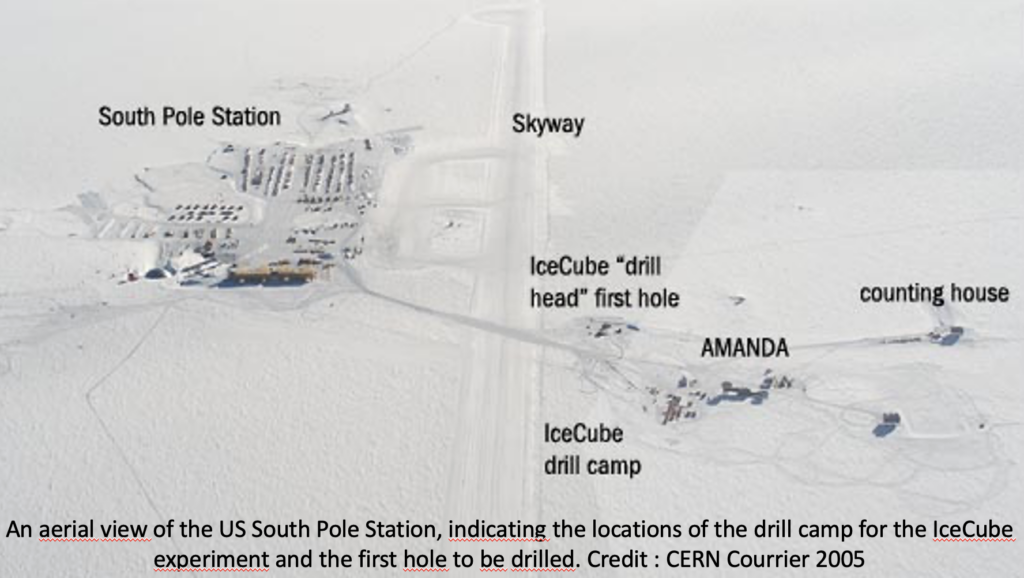
IceCube is the world’s largest particle detector, located deep beneath the Antarctic surface. It uses a vast grid of more than 5000 digital optical sensors embedded in a cubic kilometer of ice to detect tiny flashes of light produced when neutrinos interact with the ice.
IceCube opens a new window onto the Universe, enabling scientists to investigate some of its most energetic and mysterious phenomena. IceCube’s scientific reach extends beyond the search for cosmic neutrino sources. With IceTop at the surface and the more densely instrumented DeepCore array embedded in the ice, the observatory also investigates the properties of neutrinos and of cosmic rays and searches for signs of dark matter.
The IceCube Collaboration brings together approximately 450 physicists at 58 institutions across 14 countries. The IIHE (ULB-VUB) contributed to the construction of the IceCube detector and continues to play a key role in its scientific programme.
The IIHE: A Leading Contributor to the IceCube Research
Today, the ULB side of the IIHE IceCube group is led by Professor Juan Antonio Aguilar Sánchez, Principal Investigator of the IceCube FNRS-IISN ULB-UCLouvain research convention, together with Professors Simona Toscano and Ioana Maris. On the VUB side, the group includes Professors Nick van Eijndhoven and Krijn de Vries. Members of the IIHE team have held important and prestigious positions within the IceCube Collaboration. Professor Juan Antonio Aguilar Sánchez has served as its Analysis Coordinator and currently chairs its Publications Committee. The IIHE currently brings together a team of around 25 people, including postdoctoral researchers and PhD students, working in astroparticle physics.
The IIHE IceCube team is actively working to address some of the most fundamental questions in modern physics. Their research focuses on several key areas: hunting for ultra-high-energy neutrinos, investigating the mysterious nature of dark matter, and analyzing cosmic rays and high-energy photons to understand extreme phenomena. Acting as cosmic investigators, they trace astrophysical neutrinos back to their origins in explosive transients and distant galaxies. Finally, the team is heavily involved in pioneering IceCube-Gen2, a next-generation detector designed to significantly expand the scope of neutrino astronomy and open new windows onto the universe.
This recognition is a moment of pride for the IIHE and for everyone who has contributed to IceCube and to the field of neutrino and astroparticle physics over the years.
Exploring the Universe Through Multiple Messengers
The IIHE (ULB-VUB) is actively involved in exploring rare cosmic events through a multi-messenger approach. Signals from the same source are analyzed across high-energy neutrino events, ultra-high-energy cosmic rays, high-energy photons, and gravitational wave detections, to explore their connections and uncover their origins. In addition to IceCube, this research draws on data from major international facilities, including the Pierre Auger Observatory in Argentina, the world’s largest cosmic ray observatory; KM3NeT, a deep-sea neutrino telescope in the Mediterranean Sea; and the Radio Neutrino Observatory in Greenland (RNO-G), an experiment designed to detect the most energetic processes in the Universe by capturing ultra-high-energy neutrinos via radio antennas embedded in the Greenlandic ice.
By providing a unique environment for innovation in detector technologies and experimental techniques, the IIHE (ULB-VUB) is at the forefront of efforts to detect the Universe’s most energetic particles. Its teams play a leading role in developing pioneering experiments, opening new avenues for the exploration of the high energy Universe.
Contact
· Prof. Daniel Bertrand (FR, EN), IIHE ULB Emeritus, former ULB-PI of IceCube, former director of the IIHE-ULB, daniel.bertrand@ulb.be
· Prof. Catherine de Clercq (NL, FR, EN), IIHE VUB Emeritus, former VUB-PI of IceCube, former director of the IIHE-VUB, catherine.de.clercq@vub.be
· Prof. Juan Antonio Aguilar Sanchez (FR, EN), IceCube PI IIHE-ULB, Juan.Antonio.Aguilar.Sanchez@ulb.be, GSM: 0483192404
· Prof. Nick van Eijndhoven (NL, EN), IceCube PI IIHE-VUB, nick.van.eijndhoven@vub.be,GSM: 32488074166
· Prof. Simona Toscano (FR, EN), IceCube researcher IIHE-ULB, simona.toscano@ulb.be, GSM: 0485531596
· Prof. Krijn de Vries (NL, EN), IceCube researcher IIHE-VUB, krijn.de.vries@vub.be, GSM: 0470620587
· Prof. Ioana Maris (FR, EN), IceCube researcher IIHE-ULB, ioana.maris@ulb.be, GSM: 0472537510
· Mme Louise Lallement Arnaud (FR, EN), IceCube PhD student IIHE-ULB : louise.lallement.arnaud@ulb.be, GSM:0492783259
· Mme Else Magnus (NL, EN), IceCube PhD student IIHE-VUB : else.magnus@vub.be, GSM: 0499769197
· Prof. Barbara Clerbaux (FR, EN), IIHE-ULB, director of the IIHE-ULB, barbara.clerbaux@ulb.be, GSM: 0491613443
· Prof. Michael Tytgat (NL, EN), IIHE-VUB, director of the IIHE-VUB, michael.tytgat@vub.be GSM: 0486473013