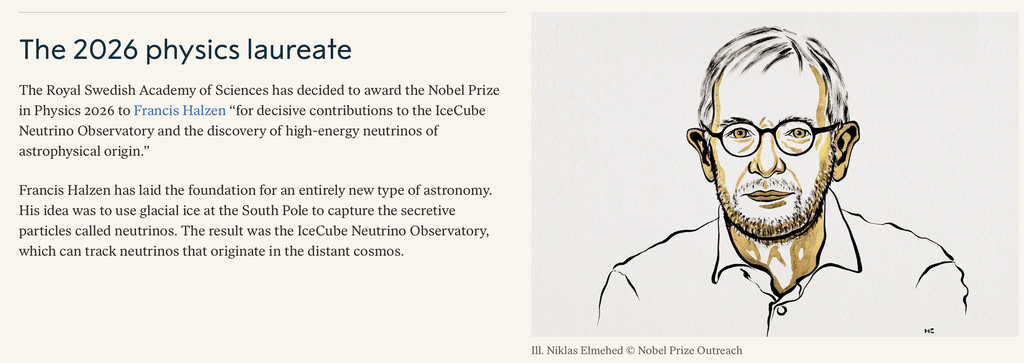
2026 Nobel Prize in Physics to Francis Halzen
The 2026 Nobel Prize in Physics has been awarded to the Belgian physicist Francis Halzen “for decisive contributions to the IceCube Neutrino Observatory and the discovery of high-energy neutrinos of astrophysical origin.”
Born in 1944 in Tienen in Belgium, he obtained his PhD at KU Leuven in 1969, and is Professor at University of Wisconsin–Madison, USA. Francis first proposed the idea of detecting neutrinos in the Antarctic ice in 1988. Through decades of vision and perseverance, that idea became IceCube, a cubic kilometre of instrumented ice at the South Pole that opened an entirely new window on the universe: high-energy neutrino astronomy.
This recognition is also a moment of pride for the IIHE institute and for everyone who has contributed to IceCube and to the field of neutrino astroparticle physics over the years.
The IIHE joined the AMANDA/IceCube experiment in July 1998, under the impulse of Daniel Bertrand (ULB) and Catherine De Clercq (VUB).
Today, the IIHE IceCube group is led on the ULB side by Prof. Juan Antonio Aguilar Sánchez, principal investigator of the IceCube FNRS-IISN convention, together with Prof. Simona Toscano and Prof. Ioana Maris. On the VUB side, the group includes Prof. Nick van Eijndhoven and Prof. Krijn de Vries. Three postdoctoral researchers and three PhD students complete the group.
Congratulations to Francis and to the Icecube experiment team.
The official announcement from the Royal Swedish Academy of Sciences can be found here: https://www.nobelprize.org/prizes/physics/2026/press-release/